<aside> 📘
Anthropic/Claude Series:
Building Effective AI Agents \ Anthropic
Effective context engineering for AI agents \ Anthropic
Effective harnesses for long-running agents \ Anthropic
How we built our multi-agent research system \ Anthropic
Code execution with MCP: building more efficient AI agents \ Anthropic
Demystifying evals for AI agents \ Anthropic
</aside>
Our Research feature uses multiple Claude agents to explore complex topics more effectively. We share the engineering challenges and the lessons we learned from building this system.
Claude now has Research capabilities that allow it to search across the web, Google Workspace, and any integrations to accomplish complex tasks.
The journey of this multi-agent system from prototype to production taught us critical lessons about system architecture, tool design, and prompt engineering. A multi-agent system consists of multiple agents (LLMs autonomously using tools in a loop) working together. Our Research feature involves an agent that plans a research process based on user queries, and then uses tools to create parallel agents that search for information simultaneously. Systems with multiple agents introduce new challenges in agent coordination, evaluation, and reliability.
This post breaks down the principles that worked for us—we hope you'll find them useful to apply when building your own multi-agent systems.
Research work involves open-ended problems where it’s very difficult to predict the required steps in advance. You can’t hardcode a fixed path for exploring complex topics, as the process is inherently dynamic and path-dependent. When people conduct research, they tend to continuously update their approach based on discoveries, following leads that emerge during investigation.
This unpredictability makes AI agents particularly well-suited for research tasks. Research demands the flexibility to pivot or explore tangential connections as the investigation unfolds. The model must operate autonomously for many turns, making decisions about which directions to pursue based on intermediate findings. A linear, one-shot pipeline cannot handle these tasks.
The essence of search is compression: distilling insights from a vast corpus. Subagents facilitate compression by operating in parallel with their own context windows, exploring different aspects of the question simultaneously before condensing the most important tokens for the lead research agent. Each subagent also provides separation of concerns—distinct tools, prompts, and exploration trajectories—which reduces path dependency and enables thorough, independent investigations.
Once intelligence reaches a threshold, multi-agent systems become a vital way to scale performance. For instance, although individual humans have become more intelligent in the last 100,000 years, human societies have become exponentially more capable in the information age because of our collective intelligence and ability to coordinate. Even generally-intelligent agents face limits when operating as individuals; groups of agents can accomplish far more.
Our internal evaluations show that multi-agent research systems excel especially for breadth-first queries that involve pursuing multiple independent directions simultaneously. We found that a multi-agent system with Claude Opus 4 as the lead agent and Claude Sonnet 4 subagents outperformed single-agent Claude Opus 4 by 90.2% on our internal research eval. For example, when asked to identify all the board members of the companies in the Information Technology S&P 500, the multi-agent system found the correct answers by decomposing this into tasks for subagents, while the single agent system failed to find the answer with slow, sequential searches.
Multi-agent systems work mainly because they help spend enough tokens to solve the problem. In our analysis, three factors explained 95% of the performance variance in the BrowseComp evaluation (which tests the ability of browsing agents to locate hard-to-find information). We found that token usage by itself explains 80% of the variance, with the number of tool calls and the model choice as the two other explanatory factors. This finding validates our architecture that distributes work across agents with separate context windows to add more capacity for parallel reasoning. The latest Claude models act as large efficiency multipliers on token use, as upgrading to Claude Sonnet 4 is a larger performance gain than doubling the token budget on Claude Sonnet 3.7. Multi-agent architectures effectively scale token usage for tasks that exceed the limits of single agents.
There is a downside: in practice, these architectures burn through tokens fast. In our data, agents typically use about 4× more tokens than chat interactions, and multi-agent systems use about 15× more tokens than chats. For economic viability, multi-agent systems require tasks where the value of the task is high enough to pay for the increased performance. Further, some domains that require all agents to share the same context or involve many dependencies between agents are not a good fit for multi-agent systems today. For instance, most coding tasks involve fewer truly parallelizable tasks than research, and LLM agents are not yet great at coordinating and delegating to other agents in real time. We’ve found that multi-agent systems excel at valuable tasks that involve heavy parallelization, information that exceeds single context windows, and interfacing with numerous complex tools.
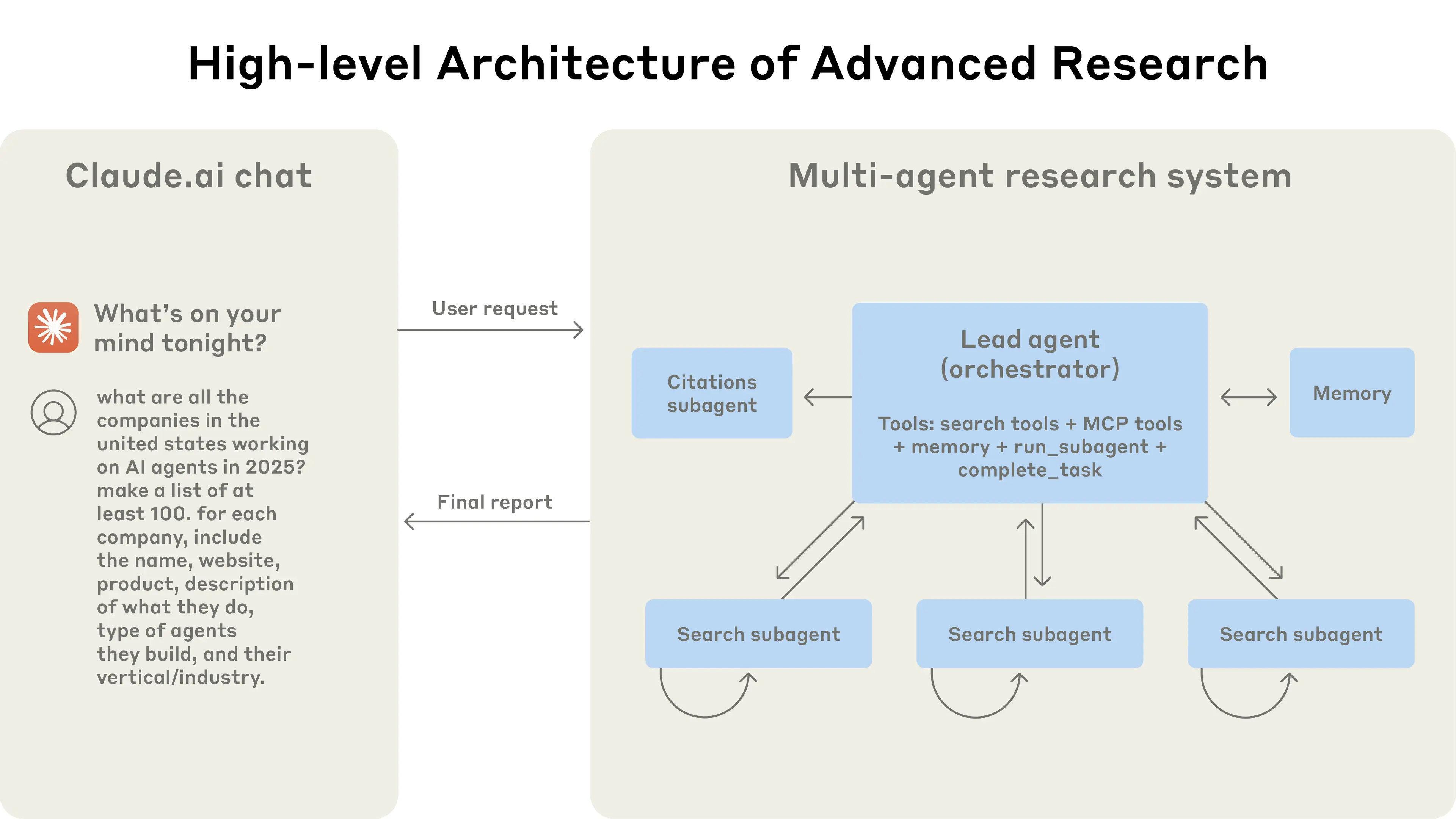
Our Research system uses a multi-agent architecture with an orchestrator-worker pattern, where a lead agent coordinates the process while delegating to specialized subagents that operate in parallel.
The multi-agent architecture in action: user queries flow through a lead agent that creates specialized subagents to search for different aspects in parallel.
When a user submits a query, the lead agent analyzes it, develops a strategy, and spawns subagents to explore different aspects simultaneously. As shown in the diagram above, the subagents act as intelligent filters by iteratively using search tools to gather information, in this case on AI agent companies in 2025, and then returning a list of companies to the lead agent so it can compile a final answer.
Traditional approaches using Retrieval Augmented Generation (RAG) use static retrieval. That is, they fetch some set of chunks that are most similar to an input query and use these chunks to generate a response. In contrast, our architecture uses a multi-step search that dynamically finds relevant information, adapts to new findings, and analyzes results to formulate high-quality answers.
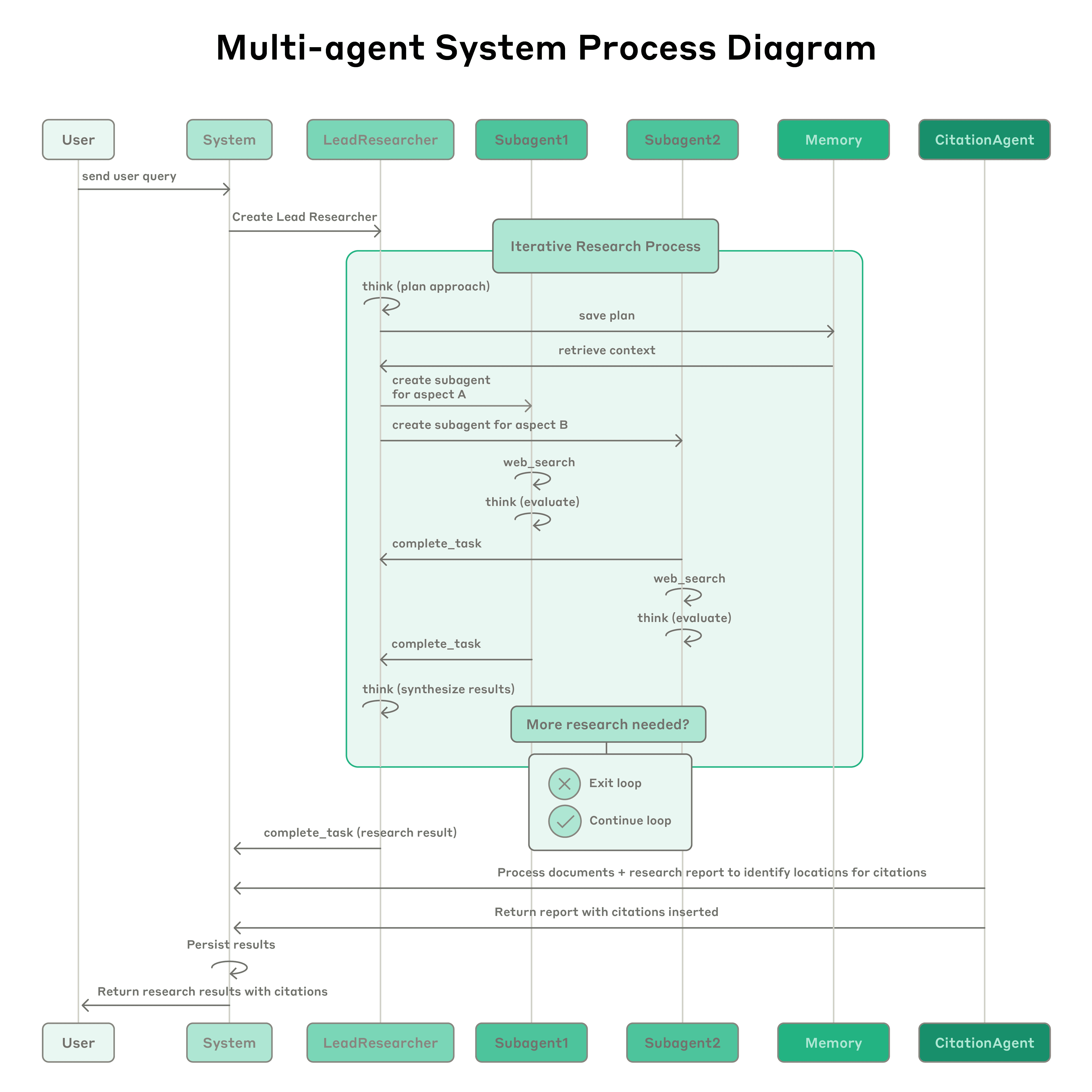
[Process diagram showing the complete workflow of our multi-agent Research system. When a user submits a query, the system creates a LeadResearcher agent that enters an iterative research process. The LeadResearcher begins by thinking through the approach and saving its plan to Memory to persist the context, since if the context window exceeds 200,000 tokens it will be truncated and it is important to retain the plan. It then creates specialized Subagents (two are shown here, but it can be any number) with specific research tasks. Each Subagent independently performs web searches, evaluates tool results using interleaved thinking, and returns findings to the LeadResearcher. The LeadResearcher synthesizes these results and decides whether more research is needed—if so, it can create additional subagents or refine its strategy. Once sufficient information is gathered, the system exits the research loop and passes all findings to a CitationAgent, which processes the documents and research report to identify specific locations for citations. This ensures all claims are properly attributed to their sources. The final research results, complete with citations, are then returned to the user.](https://www.anthropic.com/_next/image?url=https%3A%2F%2Fwww-cdn.anthropic.com%2Fimages%2F4zrzovbb%2Fwebsite%2F3bde53c9578d74f6e05c3e515e20b910c5a8c20a-4584x4584.png&w=3840&q=75)
Process diagram showing the complete workflow of our multi-agent Research system. When a user submits a query, the system creates a LeadResearcher agent that enters an iterative research process. The LeadResearcher begins by thinking through the approach and saving its plan to Memory to persist the context, since if the context window exceeds 200,000 tokens it will be truncated and it is important to retain the plan. It then creates specialized Subagents (two are shown here, but it can be any number) with specific research tasks. Each Subagent independently performs web searches, evaluates tool results using interleaved thinking, and returns findings to the LeadResearcher. The LeadResearcher synthesizes these results and decides whether more research is needed—if so, it can create additional subagents or refine its strategy. Once sufficient information is gathered, the system exits the research loop and passes all findings to a CitationAgent, which processes the documents and research report to identify specific locations for citations. This ensures all claims are properly attributed to their sources. The final research results, complete with citations, are then returned to the user.