<aside> 📘
Anthropic/Claude Series:
Building Effective AI Agents \ Anthropic
Effective context engineering for AI agents \ Anthropic
Effective harnesses for long-running agents \ Anthropic
How we built our multi-agent research system \ Anthropic
Code execution with MCP: building more efficient AI agents \ Anthropic
Demystifying evals for AI agents \ Anthropic
</aside>
After a few years of prompt engineering being the focus of attention in applied AI, a new term has come to prominence: context engineering. Building with language models is becoming less about finding the right words and phrases for your prompts, and more about answering the broader question of “what configuration of context is most likely to generate our model’s desired behavior?"
Context refers to the set of tokens included when sampling from a large-language model (LLM). The engineering problem at hand is optimizing the utility of those tokens against the inherent constraints of LLMs in order to consistently achieve a desired outcome. Effectively wrangling LLMs often requires thinking in context — in other words: considering the holistic state available to the LLM at any given time and what potential behaviors that state might yield.
In this post, we’ll explore the emerging art of context engineering and offer a refined mental model for building steerable, effective agents.
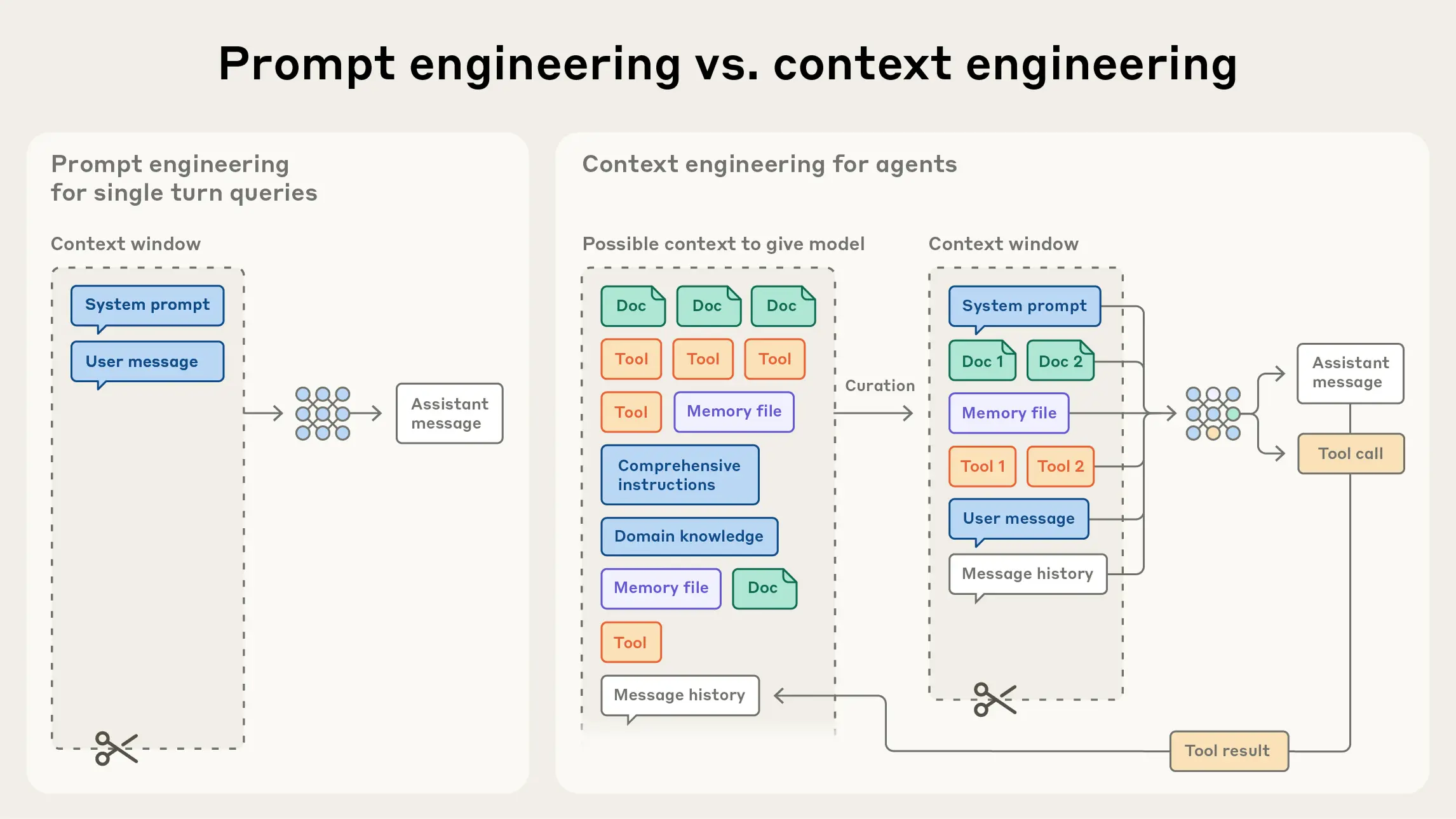
At Anthropic, we view context engineering as the natural progression of prompt engineering. Prompt engineering refers to methods for writing and organizing LLM instructions for optimal outcomes (see our docs for an overview and useful prompt engineering strategies). Context engineering refers to the set of strategies for curating and maintaining the optimal set of tokens (information) during LLM inference, including all the other information that may land there outside of the prompts.
In the early days of engineering with LLMs, prompting was the biggest component of AI engineering work, as the majority of use cases outside of everyday chat interactions required prompts optimized for one-shot classification or text generation tasks. As the term implies, the primary focus of prompt engineering is how to write effective prompts, particularly system prompts. However, as we move towards engineering more capable agents that operate over multiple turns of inference and longer time horizons, we need strategies for managing the entire context state (system instructions, tools, Model Context Protocol (MCP), external data, message history, etc).
An agent running in a loop generates more and more data that could be relevant for the next turn of inference, and this information must be cyclically refined. Context engineering is the art and science of curating what will go into the limited context window from that constantly evolving universe of possible information.
Prompt engineering vs. context engineering
In contrast to the discrete task of writing a prompt, context engineering is iterative and the curation phase happens each time we decide what to pass to the model.
Despite their speed and ability to manage larger and larger volumes of data, we’ve observed that LLMs, like humans, lose focus or experience confusion at a certain point. Studies on needle-in-a-haystack **style benchmarking have uncovered the concept of context rot: as the number of tokens in the context window increases, the model’s ability to accurately recall information from that context decreases.
While some models exhibit more gentle degradation than others, this characteristic emerges across all models. Context, therefore, must be treated as a finite resource with diminishing marginal returns. Like humans, who have limited working memory capacity, LLMs have an “attention budget” that they draw on when parsing large volumes of context. Every new token introduced depletes this budget by some amount, increasing the need to carefully curate the tokens available to the LLM.
This attention scarcity stems from architectural constraints of LLMs. LLMs are based on the transformer architecture, which enables every token to attend to every other token across the entire context. This results in n² pairwise relationships for n tokens.
As its context length increases, a model's ability to capture these pairwise relationships gets stretched thin, creating a natural tension between context size and attention focus. Additionally, models develop their attention patterns from training data distributions where shorter sequences are typically more common than longer ones. This means models have less experience with, and fewer specialized parameters for, context-wide dependencies.
Techniques like position encoding interpolation allow models to handle longer sequences by adapting them to the originally trained smaller context, though with some degradation in token position understanding. These factors create a performance gradient rather than a hard cliff: models remain highly capable at longer contexts but may show reduced precision for information retrieval and long-range reasoning compared to their performance on shorter contexts.
These realities mean that thoughtful context engineering is essential for building capable agents.
Given that LLMs are constrained by a finite attention budget, good context engineering means finding the smallest possible set of high-signal tokens that maximize the likelihood of some desired outcome. Implementing this practice is much easier said than done, but in the following section, we outline what this guiding principle means in practice across the different components of context.
System prompts should be extremely clear and use simple, direct language that presents ideas at the right altitude for the agent. The right altitude is the Goldilocks zone between two common failure modes. At one extreme, we see engineers hardcoding complex, brittle logic in their prompts to elicit exact agentic behavior. This approach creates fragility and increases maintenance complexity over time. At the other extreme, engineers sometimes provide vague, high-level guidance that fails to give the LLM concrete signals for desired outputs or falsely assumes shared context. The optimal altitude strikes a balance: specific enough to guide behavior effectively, yet flexible enough to provide the model with strong heuristics to guide behavior.